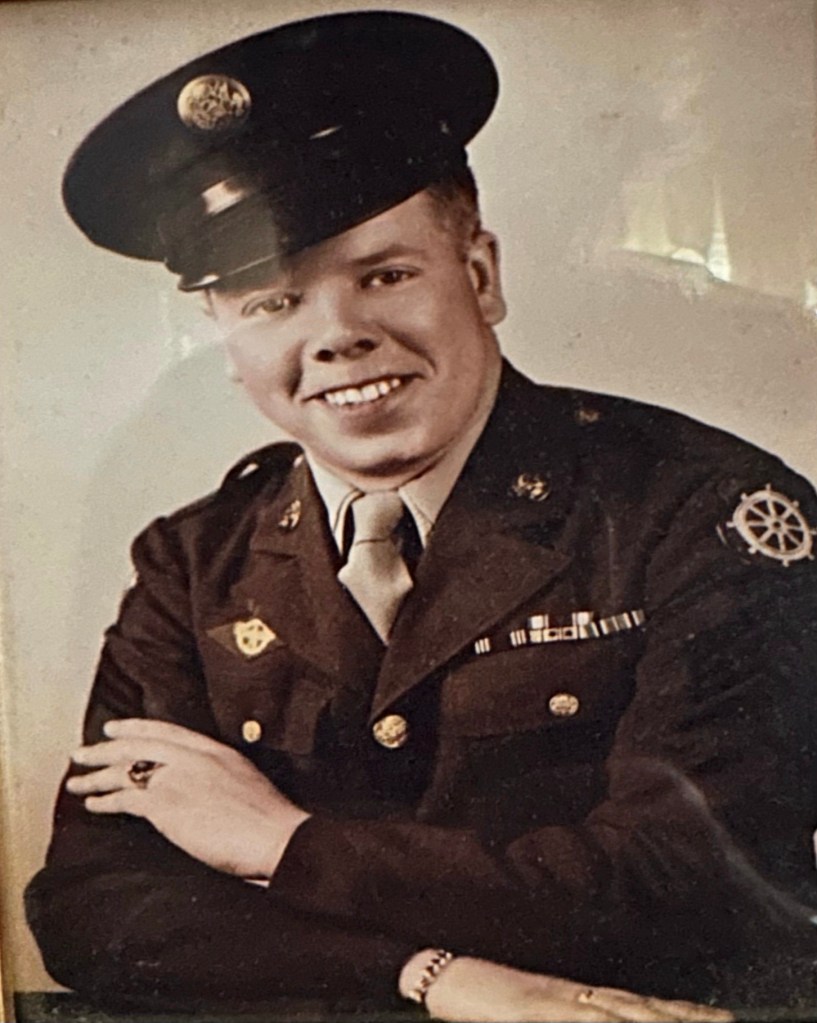
Like so many of the men and women of the greatest generation, my father seldom ever talked about his service during World War II. There are some stories dad told me and my brothers and sisters which I will relate to you shortly to the best of my recollection.
It is almost impossible to access dad’s records since they were destroyed in a fire at the record storage facility in St. Louis, Missouri. We do know that dad registered for the draft when he was 19 years old so that would have been in 1942. The invasion of Guadalcanal took place on August 7, 1942, and the island was declared secure on February 8, 1943.
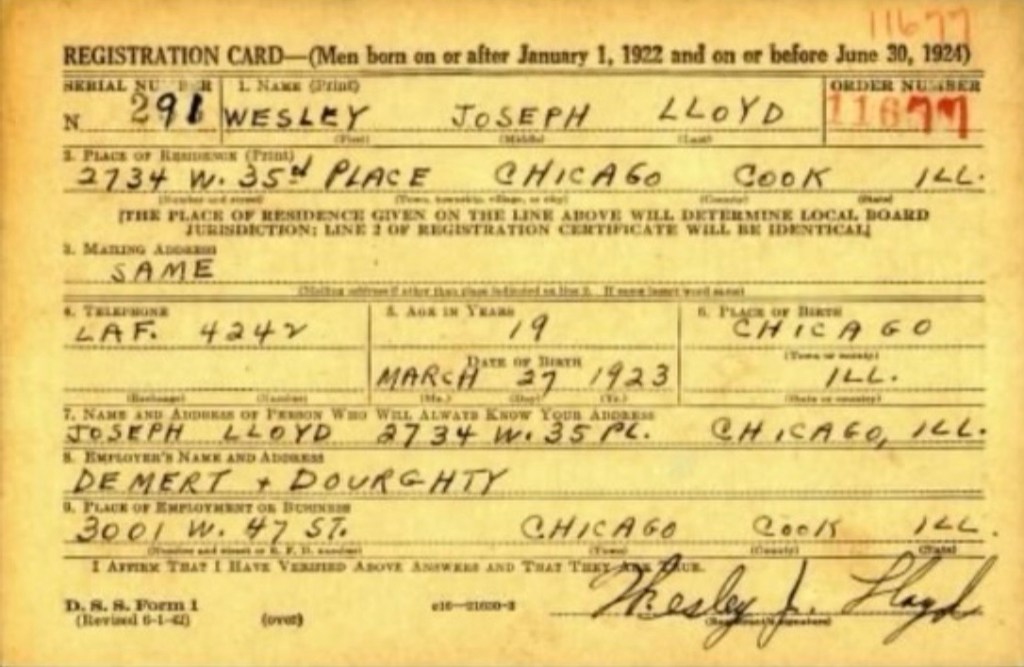
We know that dad volunteered to serve. Dad and his best friend Art Albretch went together to the recruiting office. After filling out the paperwork, the clerk stamped dad’s papers “Navy”. Dad told the clerk that he didn’t want to be in the Navy, so the clerk changed it to “Army”. Art, who was right behind dad at the induction center, had “Army” stamped on his papers. They thought that there was a good chance that they would serve together but dad went to the Pacific and Art went to Europe.
Dad was inducted into the Army on March 1, 1943. He was placed in the 369th Engineer Special Service Regiment stationed at Camp Claiborne in central Louisiana. On May 8, 1943, his unit was transferred to San Bernardino, California and on November 29, 1943, his unit was transferred to Camp Beal, California. His unit was staged for overseas deployment at Camp Stallman, California from February 28, 1944 to March 6, 1944 when the unit departed from the port of San Francisco aboard the USS Rochambeau. An interesting fact: John F. Kennedy sailed to New Caledonia on the USS Rochambeau in March 1943 almost exactly one year before dad sailed on her.
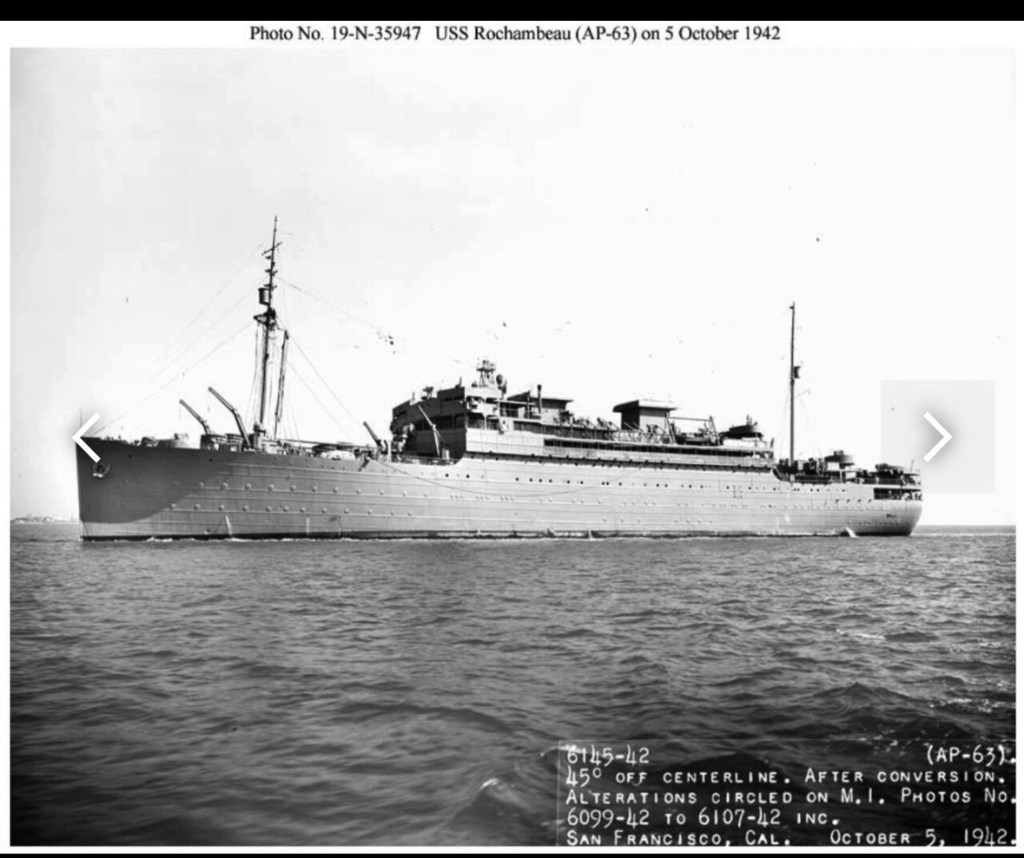
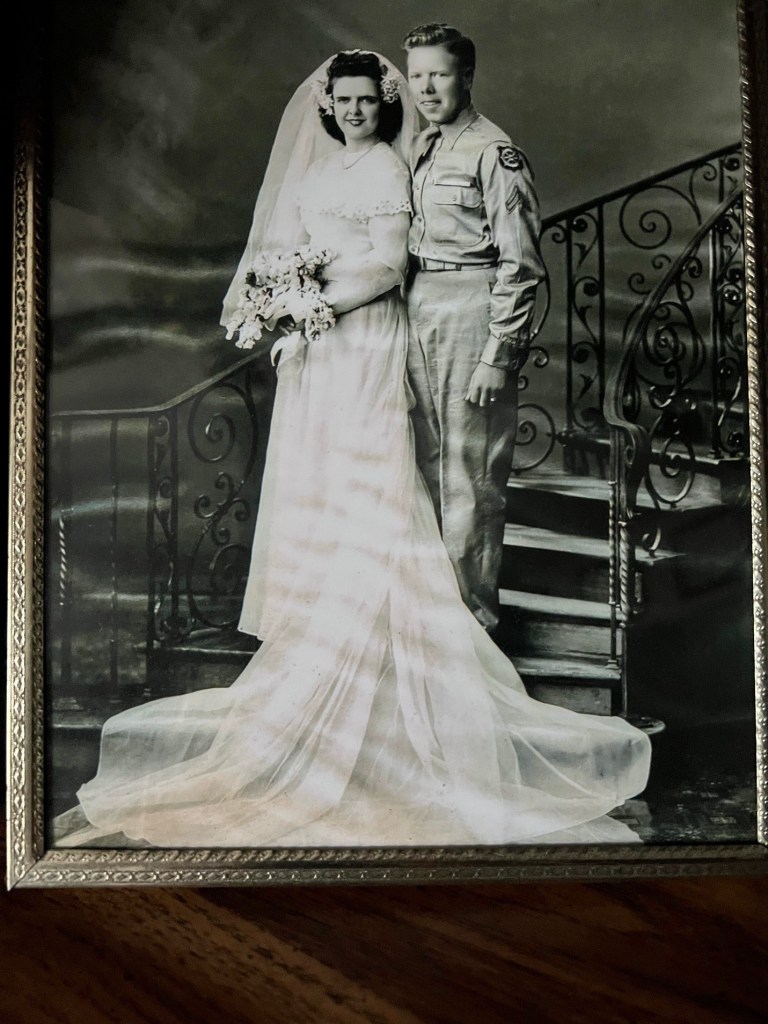
The Rochambeau arrived at Guadalcanal on March 24, 1944. We cannot find any record as to when dad left Guadalcanal. Most likely it was some time in 1945 because dad and mom were married in Chicago in 1945 and dad was in uniform.
Dad’s unit moved from Guadalcanal to the Philippines on May 16, 1944 but dad never went to the Philippines. We know that he was sent back to the United States to attend Officer’s Candidate School but we don’t know what date. After the Japanese signed the surrender documents on September 2, 1945, dad had had enough of Army life and he had enough service points to be discharged. He was formally discharged from the Army on January 15, 1946: two years and ten months of service to his country.
The following are some of the stories I remember from dad.
Dad qualified as an expert marksman on the rifle range but never talked about firing a rifle. At some time during his assignment on Guadalcanal, dad was assigned an office job and his rifle was exchanged for a pistol.
While dad’s unit was assigned to a base in California, they spent some time in Arizona. Dad was assigned to the “railhead”. It was a stop on the road with a gas station and general store. His job was to show truck convoys where to turn off the road to get to the training area. There was seldom any traffic and he got bored. The store owner had a daughter and a pet monkey. He liked dad so he let him borrow his motorcycle so he could impress his daughter and he didn’t mind dad teasing his monkey. Dad didn’t care to impress the daughter and he stopped teasing the monkey after it bit him.
Dad didn’t like the idea of spending eighteen days sleeping in the hold of the Rochambeau in transit to Guadalcanal across Japanese submarine infested waters. Weather permitting, dad slept on the deck.
When the Rochambeau arrived at Guadalcanal, his unit disembarked and encamped on the beach. The Marines enjoyed watching the Engineering Regiment set up their tents but not as much as watching the tide come in and flood their encampment. The Marines also enjoyed watching them break camp and relocate to higher ground. Their permanent encampment was near the airstrip named “Fighter 1”
Dad said that there was live ammunition laying everywhere. The officers confiscated rifles so that no one could shoot them or intentionally wound themselves.
One of the men in his unit was cleaning coconut trees for a construction project. A coconut hit him in the shoulder and broke it. That coconut got him a free ride home.
Evidently dad did something to earn himself KP duty. He was assigned to scrub cooking pans with scalding hot water. The water scalded his hands so bad that he had to spend two weeks in the barracks, drawing no duty and resting, until the burns healed.
Dad said that his unit would swim in the Tenaru River when off duty. Soldiers carrying rifles patrolled the shore watching and shooting crocodiles who were out looking for a fresh meal.
Cooks would take a boat out into Savo Sound and drop hand grenades into the water. The explosions killed or stunned the fish. The fish would float to the surface to be gathered by the cooks and fresh fish would be on the dinner table.
As the Marines island hopped north capturing Japanese held islands, US pilots realized that the Japanese were building coconut log gun emplacements and our bombers were having difficulties destroying them. Dad’s unit built mock emplacements on Guadalcanal so the pilots could develop a strategy to best destroy them.
After dad returned to the United States and he and mom married, mom moved to New Orleans to be near dad. Dad lives on base and mom lived in a one room cottage near the base. Things seemed to be working out pretty well for mom as she adjusted to life outside Chicago until the night she was awaken by a cow on her front porch. She didn’t like that at all and wanted dad to stay with her. We don’t know how often but we do know that dad snuck off base, technically “Absent without leave”, to be with his new wife.
When mom relocated to New Orleans she got a job at a ship manufacturing plant. Dad said that mom’s job was to knock out the pins that were holding the ship on the slipway with a sledgehammer so that the ship could slide into the water. Mom says that she worked in the office. Not sure who to believe.
Dad hated the Japanese. He said that they stole over two and a half years of his life and he never forgave them. On his first trip to Hawaii, he was offended to see so many Japanese on the islands photographing everything. He was sure that they were planning their next attack.
I often asked dad if he ever wanted to go back to visit Guadalcanal. He never hesitated to quickly respond no. I, on the other hand, have always wanted to see where my father served during the war. Dad was very fortunate. He served his country far from home where approximately 26,800 Japanese soldiers and sailors and 7,100 American soldiers and sailors lost their lives on an island almost exactly the same size as Rhode Island.
The Battle for Guadalcanal was significant in some ways and insignificant in others. It protected the sea lanes and the sea access to Australia. It was the first time that the Japanese were defeated on land with significant assistance on the sea and in the air. Unfortunately, many additional battles were yet to be fought and many more lives would have to be lost. Millions of our heroes never got to come like my hero, my dad.
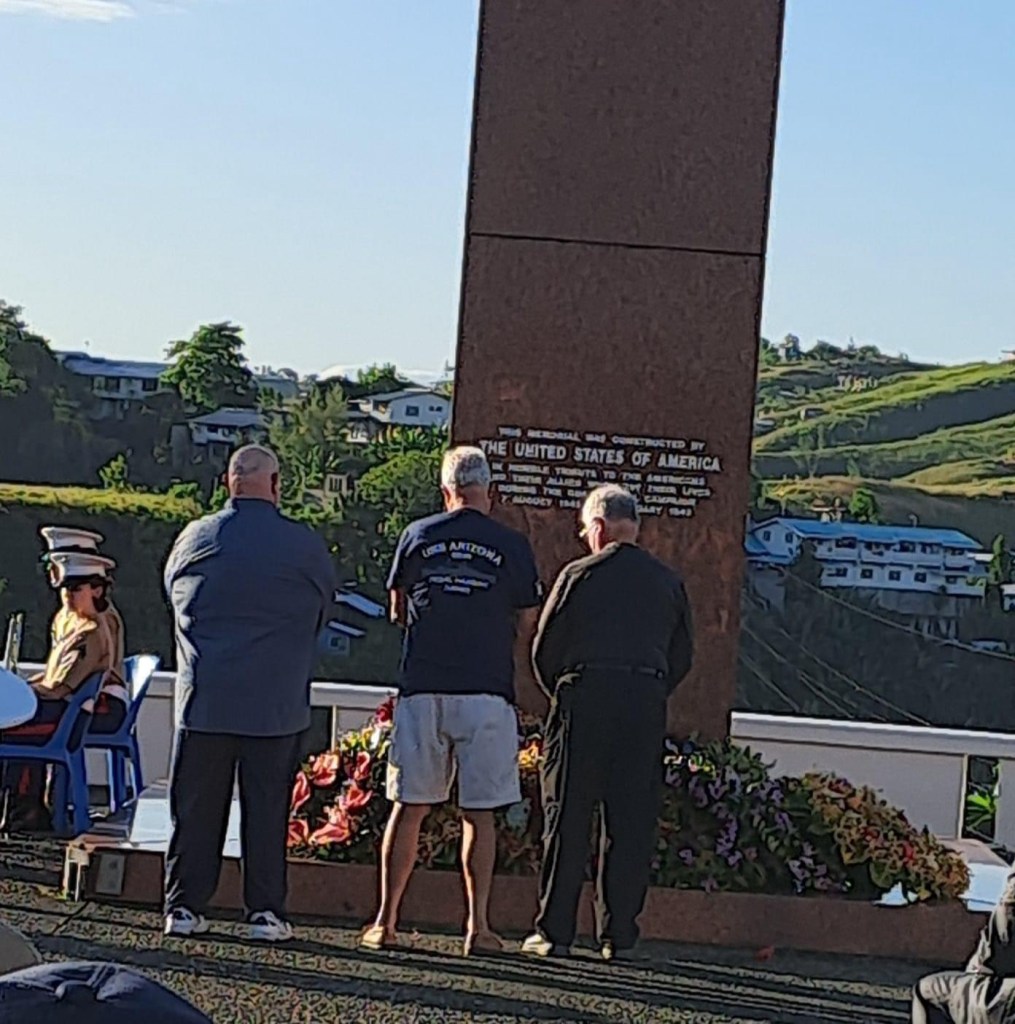
On the anniversary of the landing on Guadalcanal, our tour attended the remembrance ceremony at the United States Guadalcanal Memorial. Since my father served on Guadalcanal, I and two other men whose fathers served on Guadalcanal were selected from our tour to place a wreath at the monument. It was an honor I will never forget.

 Jim and Cory’s Adventures
Leave a reply to Kathy Cancel reply